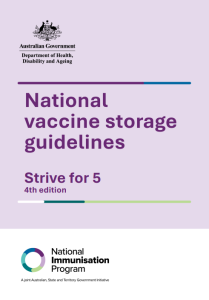

Strive for 5
Strive for 5 – The National Vaccine Storage Guidelines
If you store, handle, transport or administer vaccines, you should be familiar with Strive for 5: The National Vaccine Storage Guidelines.
The current version is the National Vaccine Storage Guidelines – Strive for 5, 4th edition, published in 2025 by the Australian Government Department of Health, Disability and Ageing. It provides national guidance for safe vaccine storage, cold chain management and temperature monitoring.
What is Strive for 5?
Strive for 5 is the name commonly used for Australia’s National Vaccine Storage Guidelines.
The phrase refers to aiming for +5°C when storing vaccines. Vaccines covered by the guidelines should generally be stored and transported between +2°C and +8°C. Many vaccines can be damaged, compromised or destroyed if stored outside this range.
Download the Strive for 5 guidelines
The latest Strive for 5 guidelines can be downloaded from the Australian Government Department of Health, Disability and Ageing website, or you may download the document here: National Vaccine Storage Guidelines: Strive for 5
Key updates and clarifications in the 4th edition
The 2025 update is worth reviewing if you operate a medical practice, pharmacy, hospital, aged care facility, community clinic, mobile service or outreach immunisation service.
Important changes and clarifications include:
Clearer vaccine fridge requirements
The 4th edition continues to focus on purpose-built vaccine refrigerators and sets out clearer minimum requirements for vaccine fridge alarms, temperature displays and monitoring equipment.
Temperature monitoring equipment
Immunisation providers must have suitable temperature-monitoring equipment, including a digital minimum/maximum thermometer, a downloadable data logger or automated monitoring system, and a portable minimum/maximum thermometer for vaccine transport or PBVR failure.
Automated monitoring and report review
The guidelines provide clearer advice on automated temperature monitoring, back-to-base alarm systems and building management systems. Automated monitoring does not remove the need to review temperature reports regularly.
Self-audits every 6–12 months
Vaccine storage self-audits are now recommended every 6–12 months, or more often if there have been equipment issues or cold chain breaches.
Cold chain breach reporting
Cold chain breach guidance now more clearly includes suspected incidents and UV light exposure, as well as temperatures outside the +2°C to +8°C range.
Updated operational guidance
The 4th edition includes updated guidance for vaccine storage, power failures, mobile and outreach clinics, coolers, vaccine management protocols and cold chain breach response.
For clinics, pharmacies and healthcare providers, the practical requirements are:
- Use a suitable purpose-built vaccine refrigerator
- Monitor the vaccine fridge with appropriate temperature-monitoring equipment
- Keep required temperature records
- Review data logger, automated monitoring or alarm system reports regularly
- Have a documented vaccine management protocol
- Have a plan for power failures and cold chain breaches
- Complete vaccine storage self-audits at the recommended intervals
If you are purchasing or replacing a vaccine fridge, check that the unit is suitable for vaccine storage and that your monitoring, reporting and backup processes match the current Strive for 5 requirements.
Enlake can help with vaccine storage
Enlake supplies medical, pharmacy and laboratory refrigeration equipment across Australia, including vaccine fridges, temperature monitoring equipment and backup power options.
If you are setting up a new vaccine storage area, replacing an older fridge, reviewing your cold chain process or planning for power failures, Enlake can help you choose equipment suited to your application.
Relevant Enlake resources: